Showing posts with label itchiness. Show all posts

Sunday, October 21, 2012

No Fleas Please!


Most of the leaves have fallen from the trees. The last of our tomatoes have been harvested and sit ripening (I hope) on the kitchen counter. The fields surrounding our farmhouse lay brown and dry. Flocks of geese crisscross the sky on their southward hunt for food. As the natural world settles in for the long winter ahead, it is easy to become complacent about parasite protection in our pets. But just as box elder bugs dot the sunny sides of our houses looking for a way inside, fleas are also on high alert for a hiding spot. If you are as unlucky as several of my clients in this fall, these fleas might just hijack your dog or cat.

The three flea cases we saw most recently were discovered during routine examination. The owners were taken completely by surprise by the discovery. It is very important to know that not all pets with fleas are itchy, just as not all itchy pets have fleas.

The first two cases were canine housemates. While I examined the head of one of the dogs, the owner nonchalantly asked what kind of tiny bug it was she just saw swim through the fur on the back end. Fleas can be tricky little buggers. They usually aren’t seen bouncing off the pet as in cartoons. In fact, more often than find fleas, we will find “flea dirt” on the pet’s skin.
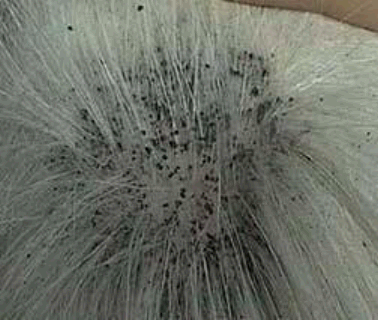
The many black specks seen on this cat's back are flea dirt.

Flea dirt is the digested blood meal taken from the pet. Flea dirt is flea poop. A special fine toothed comb is used to brush through the pet’s fur and collect flea dirt (and sometimes fleas). When wet, the flea dirt turns back into blood making diagnosis grisly but firm. Both dogs in this family were covered in flea dirt, suggesting the infestation was fairly long standing. Yet neither dog was itchy, missing any hair nor had any sores on their skin!

The other surprising case involved a puppy presented for a spay. Several fleas were found while her abdomen was clipped for surgery. She did not have any noticeable flea dirt, so we suspect her infestation was quite recent. Much to our dismay, her disbelieving owner was certain she must have gotten fleas in the clinic. Indeed anywhere animals congregate there is risk of fleas and other infections being shared. This is why I strongly urge my clients to apply flea and tick preventative to their pet before taking them to the kennel for boarding regardless of the quality of the kennel. However, the likelihood that this puppy caught several fleas during the brief time she spent alone in her stainless steel kennel awaiting surgery is quite low. In fact, it was later learned that her hunter owner had briefly brought a flea-ridden dead animal into the house. (Fleas flee dead animals quickly making it even more important for hunting dogs to remain on a preventative throughout hunting season!)

Flea eggs and flea dirt (poop) in carpet beside the head
of a pin.
Many pet owners justify not using a flea product because they believe if fleas were present they would have been bitten themselves. Fleas do bite people if the opportunity arises. The owner of one of my flea-infested feline patients explained she sprayed insecticides around her bed every morning because she kept finding bites on her skin! Since treating all the cats in the home for fleas and doing environmental clean-up, the number of human bites are decreasing.

A diagnosis of fleas is relatively easy and satisfying to make. The treatment aftermath is something else entirely.

1.     Whenever we meet a pet with fleas, the clinic is vacuumed thoroughly to remove any fleas or flea eggs. Then we close down that examination room and spray all surfaces with an insect growth regulator (IGR). Our IGR spray kills adult fleas and halts reproductive development of immature fleas.
2.     The pet owner must undertake aggressive cleaning at home as well. This includes frequent vacuuming of all surfaces; laundering bedding in hot water and high heat drying; fogging, bombing or spraying with an IGR; and treatment of ALL animals in contact with the affected pet.
3.     USE EXTREME CAUTION AND CONSULT YOUR VETERINARIAN if using an over-the-counter product not specifically prescribed for your situation. Many products are deadly to cats, while another product very well tolerated by dogs and cats is fatally toxic to rabbits!
4.     When fleas persist it is not generally insecticide resistance but failure to use effective flea products as directed. Did you remember to treat your cousin’s beagle  who hangs out at your place every few weeks? Did you remember to treat your own pets every month for at least 3 months? Certain stages of the flea cannot be killed so if you stop treating before these flea babies have matured and are susceptible to killing, you will have a perpetual flea problem.
5.     Rabbits and rodents are notorious flea reservoirs. If you have a lot of rabbits in your yard, your pets are at high risk of wandering into the flea circus at some point. Removal of rabbits and their dens as well as outdoor insecticide treatments are helpful in the control of fleas on your pets.

Fleas carry all sorts of diseases. Ever heard of the Plague? This devastating historical disease that decimated European human populations during the Middle Ages still crops up from time to time, even in the United States. Fleas carry a tapeworm that dogs and cats contract from ingesting the fleas crawling on their skin. Cats also can acquire a dangerous form of infectious anemia caused by a flea-borne microorganism.

Prevention of disease is always the best medicine. Avoid a case of the heebie-jeebies by using a flea preventative in your pets. A few dollars a month spent on a good preventative is a reasonable insurance investment. Your pet's comfort and safety as well as your sanity may be at stake!

Sunday, June 10, 2012

Witchy Over Itchy

As a new mom at Little League, I was relieved to bump into an acquaintance mother in the stands. She had brought her adult Boxer and my American Bulldog puppy was enamored of her.

As the two dogs rough-house in the grass near us, the woman suddenly announces how angry she is at her current veterinarian (always dangerous territory)! Turns out her veterinarian said not to breed her female dog because she has allergies. Before I can respond another mom interjects dismissively, "Pfht! All dogs have allergies." Feeling ambushed, my veterinarian instincts overcome my social delicacy instincts and I blurt out "No! Allergies-are-an-expensive-and-difficult-problem-for-many-owners-and-terrible-for-dogs. I-even-know-of-one-dog-who-was-put-down-because-of-her-suffering!"

You could hear a pin drop.

While the Boxer's owner stares at me with mouth slightly agape, I try to salvage the conversation by asking calmly about her dog's symptoms and severity. To no avail. The conversation has died and cannot be resuscitated. At least for this baseball game, I have become a pariah among Little League moms.

Having had some time to reflect on the scene, I find myself agreeing with Second Mom's statement that "all dogs have allergies." It certainly seems that way some days as dog after dog visits my veterinary clinic with complaints of painful ear infections, inflamed paws and uncontrolled itching.

Yes, many dogs like people have mild seasonal allergies. We don't discourage people who suffer from hay fever from procreating. We don't even stop people with life-threatening peanut or shellfish allergies from marrying and having kids. The thought is just plain ludicrous. But dogs are not people, obviously. It is our responsibility in this age of pet-overpopulation to be cautious and judicious about which dogs we allow to reproduce and why. Many allergies in pets have a hereditary component. If not breeding a known allergy sufferer might prevent similar suffering in future canine generations, all the veterinarians I know would be in favor of that.

Itchy Boxer scratches at ears
Canine allergies vary in cause and severity. Like bee sting reactivity in people, canine allergies may worsen with time. A mild seasonal allergy causing red, itchy eyes for a few weeks in a puppy can worsen with successive allergy seasons. The season itself may lengthen to all year round as the pet accrues additional allergy triggers including house dust mites and other unavoidable airborne particles. Symptoms too may worsen with some dogs living their entire lives with expensive, difficult-to-manage chronic ear infections, anal gland problems, and skin disease. Gastrointestinal upset ranging from picky eating, frequent vomiting and soft stools may indicate food allergy, which are historically difficult to diagnose and very expensive to manage.

Yes, Second Mom, so many dogs suffer from some degree of allergies I think most pet owners do consider it normal. The constant foot licking some dogs do, for example, may not be merely boredom. Butt scooting, reported with hilarity as if the dog performs the act for comic relief, may actually signal a food allergy. And let us not forget cats whose allergies are perhaps more challenging to manage than dogs': the puke piles you step in several times a week are not strategically placed to annoy. And not all bald cat bellies and legs are due to obsessive-compulsive disorder. Just because these things are common does not make them normal and acceptable in our pets!

Faced day-after-day with disgruntled, frustrated pet owners and miserable pets who hate taking the medicine that will provide merely temporary relief from their allergy symptoms, I forgive myself the "faux paw" of erupting at my fellow Little League moms. I hope they will forgive me knowing my rudeness is just exuberance on behalf of my afflicted patients.

P.S. Some breeds of dogs are more commonly affected by allergies than others (remember, that hereditary component of allergies?) so do your research befor acquiring a new pet. Ask the breeder or former owner if the dog or its parents have a history of allergies or allergy symptoms (itchy skin, excessive licking, ear or anal gland problems, chronic upset stomach) so you can go into the adoption with eyes wide open.