Showing posts with label spay. Show all posts

Sunday, June 22, 2014

Who's Your Daddy? A Cat Reproduction Primer

Tis kitten season once again. Having a rural veterinary practice means this time of year many of my kitten exams involve baskets full of mewling, velcro-toed feline fur-babies. What is striking about these litters of kittens is how dramatically different the siblings are from each other: we might see a calico, a black-and-white tuxedo, several tigers in various hues and a long-haired tortoiseshell -- all from the same mother, or queen. In contrast to kittens from a cattery where matings are tightly regulated to achieve traceable genetics, kittens from farm cats and neighborhood strays have the potential for a very mixed up paternity. The reason for the physical variations among kittens of the same litter is very Jerry Springeresque: each kitten from the same litter, carried and born at the same time, can have a completely different father!

It's called "superfecundation" (kinda sounds like a Mary Poppins song!) and is a very common feline reproductive condition. Technically it means that during a single heat cycle two or more eggs become fertilized by different sires during separate matings. Superfecundation is not unique to cats as it can occur in litters of puppies and occurs with some frequency among human twins (talk about Jerry Springeresque!). However, special features of feline reproduction makes superfecundation almost inevitable.

Whereas canines generally go into heat only twice a year, felines are "seasonally polyestrus," meaning fertility is triggered by lengthening hours of daylight and fertile periods repeat multiple times during this season of longer days. Queens in the northern hemisphere generally only stop going into heat during late autumn and early winter.  Depending on the season, genetics and environmental conditions, puberty in young cats can begin as early as 4 months of age. A female kitty might find herself "in trouble" even though she herself is barely weaned!

As every farmer knows, when cats do start going into heat, it is an endless cycle of mating, pregnancy and kittens. In fact, cats can go into heat, or estrus, every 14-21 days. Pregnancy itself lasts about 60 days. Queens can become re-impregnated even while nursing a litter of kittens because many begin cycling again about 10 days after delivery. A particularly successful queen can raise up to three litters a year. In short, cats breed like rabbits.

But just because cats are ready to reproduce at the drop of a hat throughout most of the year is not what leads to kittens from different fathers (although it probably contributes). Cats are unusual among domestic animals in that they are "reflex ovulators." As opposed to most species (including humans) in which an egg or eggs are released during ovulation regardless of whether mating occurs, actual intercourse is almost always required to stimulate release of an egg from the feline ovary.

Feline ovulation relies upon a complex chain of reactions -- the vaginal-spinal-hypothalmic reflex -- triggered during copulation from sharp barbs on the tom's penis. During the three to eight day fertile period during a given estrus cycle, a queen might mate with a number of toms. Each mating might result in the fertilization of one or more eggs released in response to the copulation. A typical litter consists of four to five kittens. Theoretically, then, each might be only half-brother and half-sister to the others.

Because cats are so prolific, the supply of kittens is always greater than the demand for pets. It is a bittersweet feeling for a veterinarian to behold that basket of adorable, genetically fascinating feline offspring. While we love cuddling the cute little kittens as much as the next guy, we also wish for some kind of cheap and easy birth control for cats. In some countries outside the U.S. oral contraceptives are available, but because they have been shown to cause horrible uterine infections, breast cancer and diabetes in the queens they are considered inhumane and are banned here. So, at this time, we are left with ovariohysterectomy (a.k.a. spay) or removal of the female reproductive tract.

Trap, neuter, release (TNR) programs are available to control feral feline populations. By systematically
surgically sterilizing all the cats in a certain locale, you not only prevent them from breeding but also reduce the introduction of unsterilized cats into the "fixed" cats' established territory. Owners of pet cats must also take steps to remove their individual feline from the over-population problem by having it spayed or neutered as soon as medically indicated. All too often, owners who haven't prepared for the relatively minor cost of sterilizing one cat find themselves seriously financially overwhelmed with litter after litter of kittens, all of whom also begin reproducing at a prodigious rate. And no, cats do not care if the sire of her kittens is her brother or her father, so don't count on "that's gross" being an effective contraceptive in a home full of unfixed felines!

Although domestic cats do make wonderful companions with their strikingly beautiful feline features, charming personalities and funny behaviors, now you know where the term "catting around" originated!

Sunday, February 19, 2012

Happy Birthday, Kitty!

People always want to know how old their dog or cat is in human terms. The rule of thumb for dogs has been one dog year equals seven human years, but we know that it not exactly right. Little dogs like Bichons tend to live longer than big dogs like Newfoundlands. Also the first few years of a dog's life are accelerated. A one-year-old dog is capable of reproducing and so it is definitely not the equivalent of a seven-year-old human (unless you believe those crazy tabloids)!

Unlike dogs, after the first few formative years of life, the ratio of cat years to human is about 1:4. As you can see, a feline surpassing 20+ years is deserving of a Willard Scott-esque birthday celebration!

Cat's Age               Equivalent Human Years
 1 year                    15-18 years
 2 years                   21-24 years
 3 years                        28 years
 4 years                        32 years
 5 years                        36 years
 6 years                        40 years
 7 years                        44 years
 8 years                        48 years
 9 years                        52 years
10 years                       56 years
11 years                       60 years
12 years                       64 years
13 years                       68 years
14 years                       72 years
15 years                       76 years
16 years                       80 years
17 years                       84 years
18 years                       88 years
19 years                       92 years
20 years                       96 years
Adapted from Think Like a Cat: How to raise a well-adjusted cat -- not a sour puss by Pam Johnson-Bennett


Here are some tips for helping your kitty reach his or her "centennial" celebration.

  1. Schedule annual wellness exams with your cat's veterinarian even though vaccines are not due. Most progressive veterinary clinics now booster feline vaccines only every three years. That's the equivalent of 12 years between doctor visits in human terms! Screening bloodwork should be performed periodically (and at least annually in senior cats) to catch certain diseases early. Early detection allows for easier management and a longer, happier life.
  2. Spay or neuter your kitty to avoid medical and behavioral problems that may result in accidental death, illness or euthanasia.  
  3. Feed your cat a high quality cat food but limit portions! Obesity is a huge problem in felines leading to diabetes, arthritis, heart disease, and skin problems from inability to groom. Most cats do not get enough moisture in their diets and suffer from GI and urinary problems as a result. Train your kitty early on to enjoy quality canned or moist foods. Dry food does not -- I repeat, does not -- prevent dental disease.
  4. Dental disease is a common and painful condition in many cats, and it negatively affects their overall health. Ask your veterinarian for advice on how to prevent and manage dental disease in your cat. Just like people, most pets should have their teeth professionally cleaned (i.e., by their veterinarian) periodically.
  5. Know what plants and household items are potentially toxic for your cat to avoid tragic illness or death. Also, PLEASE remember very few human medications are safe for cats. Some over-the-counter flea and tick treatments are OK for dogs but are deadly for cats!
  6. Environmental enrichment can improve the quality and length of your cat's life. Many feline diseases are linked to stress. Learn as much as you can about feline behavior and play with your kitty every day. Especially in multi-cat households, make sure you have provided the proper resources for cats that may not get along all the time. A rule of thumb for litter boxes is "1 per cat plus 1." That means if you have three cats, you should have four litter boxes. Also properly placed scratching posts may eliminate the supposed need for declawing. By "properly placed" I mean in highly visible areas the cat has chosen, not the owner!  
Sadly, even with proper care and the best intentions some cats do not live to ripe old age. It is no different with us humans (I'm thinking of the fit and trim 30-somethings who die tragically from cancer or accidents). However, cats who receive proper exercise and nutrition, regular medical and dental care, and environmental enrichment will have an improved quality of life no matter how many candles are on their tuna cake.

Sunday, January 22, 2012

A Graphic Reminder on the Importance of Spaying Your Pet

Spay and Neuter. You've heard it all before. Let's review...
  • You should spay (female) or neuter (male) your pet to avoid inadvertently increasing the homeless pet population. Nationwide there is an overload of unwanted pet animals. Humane shelters can't find homes for all the stray and surrendered dogs and cats out there already.  
  • Your pet should be "fixed" to prevent unpleasant behavioral issues such urine marking, roaming, aggression, vocalization and "in heat" behaviors.  
  • Spaying and neutering reduces or altogether eliminates certain dangerous medical conditions. Surgical removal of the testes, uterus and ovaries obviously means your pet will not develop cancer in these organs. Risk of mammary cancer (especially in dogs) is reduced dramatically with spaying before the onset of puberty. Life threatening uterine infections are a common preventable condition as well, and that's what I want to talk about today!
I have seen far too many unspayed dogs and cats presented for life threatening uterine infections. These animals are typically older and usually have never been bred. Recently, I was presented with a senior kitty who had had one litter of kittens years ago, but was so nervous at the vet she had never been spayed after an initial vaccination series. Now the owner noticed bloody discharge from the vulva. The kitty, Tina*, was not showing signs of a urinary tract infection such as frequently straining to pass small amounts of urine. The owner was certain Tina could not be pregnant, but she had not had normal heat behavior for some time. My physical examination confirmed that Tina had an open pyometra, or uterine infection.

A feline pyometra after surgery. An incision was made into
 one uterine horn to visualize (and smell!) the contents,
a mixture of blood, pus and bacteria.  
There are two types of pyometra. An "open" pyometra means the cervix is dilated and the infection can leak out somewhat. A "closed" pyometra means the cervix is tightly closed, and pus builds up inside the uterus without any outlet. Either type of pyometra is bad news and requires immediate aggressive action (nearly always surgery). However, a closed pyometra is often worse for several reasons. Veterinary intervention may be delayed with closed pyometra because it may be harder for owners to identify a problem with their pet. Aside from the foul discharge associated with open pyometra other symptoms of a pyometra are vague and sometimes subtle. A pet suffering from pyometra may have decreased appetite, vomiting, diarrhea or lethargy. A classic sign is drinking more water and urinating more, but this is again a non-specific symptom associated with many serious problems commonly seen in older pets. Because animals with closed pyometra are usually not presented to the veterinarian as early in the disease, these pets are usually much, much sicker when they finally are diagnosed. Tragically, some of these pets have a ruptured uterus and are septicemic with infection in their bloodstream by this point. Many owners elect humane euthanasia rather than pursue treatment.

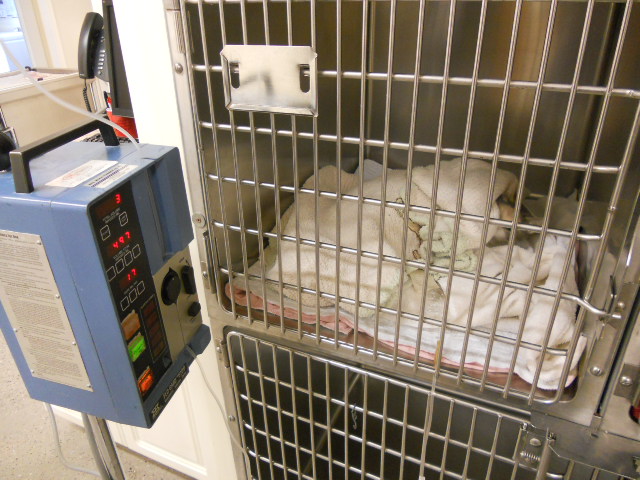
Tina remained in intensive care on IV fluids after
 surgery to support her internal organ function during
recovery.
Fortunately for Tina, her cervix was open and her owner wasted no time seeking veterinary care. After running comprehensive blood work to identify if Tina had any other underlying diseases, she was hospitalized overnight on intravenous fluids and started on antibiotics. The next morning she had the surgery that I wish she'd had done years ago -- she was spayed. A pyometra spay is more complicated, more risky and more expensive than a spay on a young healthy animal for obvious reasons. The uterine horns are filled with pus. If the uterus ruptures (which is more likely when the cervix is closed and the uterus is like an over-inflated balloon ready to pop), there is horrible bacterial contamination of the entire abdomen! Plus the animal is often systemically very ill and so requires aggressive supportive care in the hospital before and after the surgery, and she may have a slow recovery at home.

The lesson here is prevention. As a veterinarian I hate seeing my clients struggle with the decision of whether to pursue costly treatment for their senior pet's pyometra or to euthanize her. I have seen numerous old dogs and cats go on to live many happy years after surgery for pyometra, so it is usually well worth the effort! Still it is cheaper and safer to spay your pet when she is young and healthy. Please avoid the heart-ache and financial burden that comes with waiting too long to spay.


* Name changed to respect owner privacy.