Showing posts with label rehabilitation. Show all posts

Sunday, December 16, 2012

A Christmas Miracle: Winter's Tale

One of the best parts about working with animals is witnessing their inspirational response to adversity. Indeed, most animals are so stoic that it can be very difficult to tell they are ailing at all. Sure, this tendency to suffer in silence may be rooted in an instinctual unwillingness to show weakness to potential predators. After all, a limping, moaning sheep is perceived as easy pickings by a hungry wolf. Nevertheless, injured or disabled animals often display remarkable endurance and adaptability which can be a model for our own behavior in the face of adversity.

This week I met a dolphin named Winter at Clearwater Marine Aquarium in Florida. You may know Winter from the 2011 film Dolphin Tale. In December 2005, Winter was merely a few months old and still dependent on her mother when she became tangled in a crab trap line. Rescued in the nick of time, Winter was rushed to Clearwater Marine Aquarium for veterinary assessment. The lacerations on her face and body would heal with time, but the blood supply to her tail had been cut off by the rope for too long. In spite of all efforts, Winter's devitalized tail fell off.

Dr. Kim Everson watches Winter swim effortlessly "like a
fish." Notice the lack of Winter's tail fin .
Countless volunteers worked around the clock in Winter's tank supporting her weight to keep her from drowning, bottle feeding her a homemade concotion that approximated dolphin milk, treating her injuries and keeping her company. Soon Winter grew strong enough and surprised everyone by learning to "swim like a fish" by moving her tail stump from side-to-side. Over time, however, Winter's care givers noticed her posture changing. She was developing scoliosis of the spine due to her undolphin-like swimming.

David Kinne of Clearwater Marine Aquarium
explains to Dr. Kim Everson that "whales [and dolphins]
have no lips," so to suckle from a bottle they roll their
tongue like a taco to create a seal around the nipple.
Necessity is the mother of invention. And none understand this better than veterinarians and animal caregivers. A marine biologist cannot pick up a gallon of dolphin milk at the corner grocery. Dolphin milk must be created on the spot from a sound understanding of a baby dolphin's nutritional needs. How much fat, how much protein, which vitamins and minerals a sea mammal needs is vastly different from what a heifer calf or human baby needs.

Inventiveness is not only practiced by biologists in exotic settings of course. Take, for example, Jack,* a nearly 200-lb Bull Mastiff dog with two bad knees. Following surgery to repair one of his knees, Jack needed a lot of help getting around with steady support of his weak but massive hind-quarters. Not even the super-sized commercial sling could be coaxed up around his large thighs, so his dedicated owner invented his own sling from a tow-strap and some fleece. Now Jack is recovering comfortably and preparing for surgery in his other knee.

Here Winter swims wearing her prosthetic tail. Because
a dolphin's skin is so delicate, Winter cannot wear her
prosthesis all the time or it will chafe (even with
repeated modifications and improvements made by
The Hanger Orthopedic Group). Wearing the prosthesis is
part of Winter's physical therapy to combat her scoliosis.
When Winter's caregivers noticed her cramped posture, they too began to brainstorm. If only they could help her swim like a dolphin... Businessman and inventor Kevin Carroll heard about Winter's problem and set to work  engineering a prosthetic tail for Winter that was secure and comfortable. In the mean time, aquarium staff had to train Winter to accept the strange pressure and weight of a prosthetic tail. Once Winter was used to wearing the prosthesis, she had to relearn how to swim dolphin-style. Winter's adaptability endured. The ingenuity and dedication of her caregivers coupled with her own animal instincts to thrive have allowed Winter, now seven, to swim like a dolphin again.

Winter's amazing story does not end there with her overcoming her own physical obstacles. Winter now helps motivate disabled children, veterans and other amputees to remain positive and continue to heal. Winter appears to understand and connect with fellow amputees, and they certainly respond well to her.


North American River Otter Cooper in the water is not
hindered a bit by his hindlimb paralysis. Here he drags
himself from his nest of blankets for a swim in
his private pool.
Clearwater Marine Aquarium is home to many other remarkable residents besides Winter. There is Panama, Winter's tank-mate, an elderly dolphin suffering from bad teeth and deafness that prevented her from hunting. In order to survive, Panama had learned to beg for food (not all of it nutritious) from humans in the harbor. Then there is Cooper, a North American River Otter found in a citizen's garage with spinal injuries (perhaps he was hit by a car). Although over time Cooper has regained some motion in his hind legs he cannot be released back into the wild, so he lives quite comfortably at the aquarium where he naps, eats and plays as he sees fit. You would never guess he is paralyzed as you watch him glide effortlessly through the water!

Even dogs and cats with disabilites can surprise and inspire us. You may have seen dogs with hindlimb abnormalities trotting along in their doggie wheelchairs. Trauma or disease resulting in partial paralysis can be overcome with time and ingenuity. And these dogs don't feel self-conscious about their apparatus...just gleeful to be out on a walk! The idea of amputating a pet's limb is horrifying initially to many pet owners, but the ease with which these amputees get around following surgery is astounding. When there is no hope for its recovery, the damaged limb is often more of a hinderance than a help and there is real relief for the pet to be rid of it. Many dogs and cats become blind or deaf as they age. They adapt incredibly well. So well it might take months for the owner to recognize a change. Then the real challenge is helping owners learn to adapt with them!

*Name changed to protect privacy.


Thank you David Kinne and Clearwater Marine Aquarium for the amazing behind-the-scenes tour! The work you do to rehabilitate and release injured marine animals is as inspirational as the creatures who remain in your care permanently.


David Kinne explains how injured sea turtles in the "Turtle
Backyard" (background) will be returned to the wild. Opaque
tanks and minimal interaction (food is tossed into the tank
from a distance) are necessary to reduce stress
and avoid having them imprint on humans.
Dr. Kim Everson admires Clearwater Marine Aquarium's
modern surgical suite complete with a CO2 laser for
surgical removal of fibropapillomas, large viral warty tumors
that seriously impair some sea turtles' ability to thrive in the wild.

A sting ray allows Dr. Kim Everson to caress its fin.
Dozens of friendly, curious sting rays swim in the tank.
David Kinne and Dr. Kim Everson review the treatment board
for the rehabilitating and permanant residents of Clearwater
Marine Aquarium. Treatment boards similar to this are used in
veterinary hospitals nationwide including at St. Bernard's
Animal Medical Center to keep track of the specific needs of'
each patient.


David Kinne explains to Dr. Kim Everson how widely the
personalities of the aquarium residents vary. Winter hates herring
and will spit it right back out. Dolphin Hope is quite a "diva"
refusing to eat any fish that is not intact, while one of
the otters refuses to eat fish with heads!


Dr. Kim Everson examines a fin protector
specially made by a concerned volunteer for a
gigantic leatherback turtle. The turtle was
relearning to swim with one fin after the
opposite fin was badly damaged in an accident.
The good fin kept rubbing up against the side
of the tank and was becoming chafed until
this ingenious solution was developed.
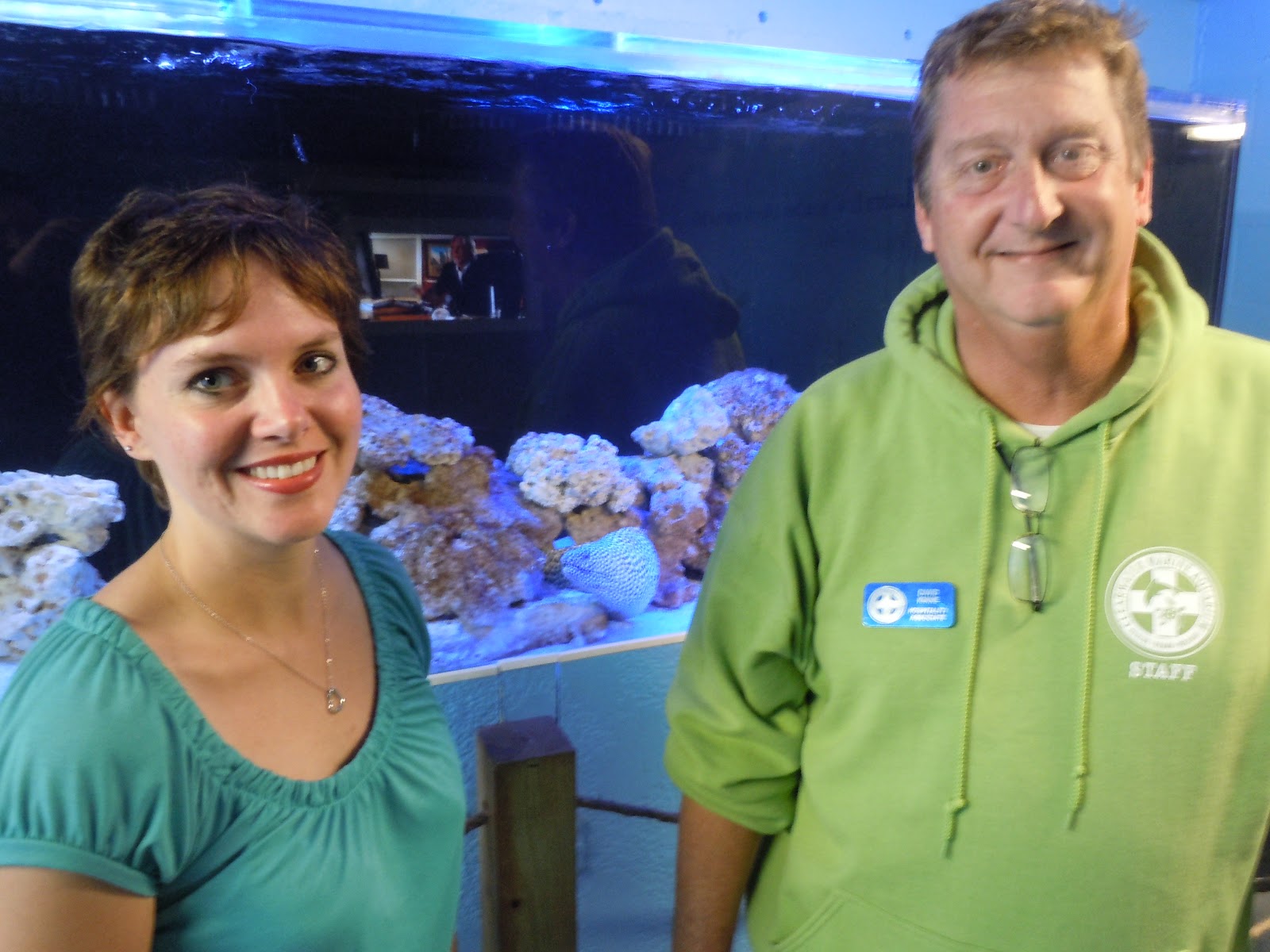
Dr. Kim Everson and David Kinne pose with Spot, a
gorgeous adult moray eel. Spot and his Cleaner Shrimp live
in companionable mutualism, with the shrimp removing and
eating parasites on Spot's skin and Spot providing protection.
The little shrimp even darts into the safety of Spot's mouth
when a perceived danger threatens. Spot wouldn't dream
of making the little shrimp lunch (even in the wild where moray
eels do not get "three square meals a day").


Sunday, September 30, 2012

Squirrel! A Wildlife Rescue Case

A little while back, my clinic got a call from a concerned citizen regarding a grey squirrel. This little squirrel kept following the female caller into her house! Every time the woman returned the young squirrel outside, he'd scurry right back into the house after her. Was he sick? Was he hungry? Or worse, did he think she was his mother?!

The beleaguered squirrel lady offered the little guy some food and drink based on her internet research of what would acceptable for a squirrel. (Although motivated by good intentions, this was a risky move which could have caused more harm than good for the young hungry animal. Please see below.) Next she attempted to locate a local licensed wildlife rehabilitator. By the wonders of Google and S.E.O., her search led her to St. Bernard's Animal Medical Center, not a licensed wildlife rehabilitation center, but a reasonable starting place for a citizen with a sick or injured wild animal.

Veterinarian Kim Everson examines a juvenile grey squirrel
before he is transferred to Wisconsin wildlife rehab
center Aves Wildlife Alliance for care.
According to Wisconsin state law, general practice veterinarians such as myself are allowed to provide emergency care for wildlife species, but within 24 hours of rescue the animal must be transferred to a licensed wildlife rehabilitator. Working with Aves Wildlife Alliance, CVT and licensed rehabilitator Tim Kneeland and I assessed the juvenile squirrel when it arrived at the clinic.

Although mildly dehydrated, hungry and ridden with fleas, the little squirrel appeared to be in pretty good shape. After we had addressed his mild dehydration, we kept him in a quiet, comfortable area away from the domestic animals until Tim could transport him to Aves for further care that afternoon. According to Beka Weiss of Aves, the young squirrel made a full recovery and is expected to transition successfully back to nature.

There are several important lessons from this wildlife rescue case.

1. One of our initial concerns was had this squirrel imprinted on people because it had been improperly handled as a baby? All too commonly a well-meaning person will find a young animal alone and incorrectly assume that is has been orphaned and requires human care. Please refer to the Wisconsin DNR website for information on "orphaned" wildlife. Not only is it illegal in many parts of the world to care for wildlife without a permit, but such interactions can also cause harm to the animal as well as humans and domestic animals.

2. Feeding a wild animal, especially one that is malnourished, requires a lot of skill and care. BEWARE internet recipes for feeding wild animals. Feeding a wild animal pet food, human food or even a bowl of milk can have dire consequences for the creature! Any website that suggests offering anything more than a shallow dish of water or human infant electrolyte solution should be considered suspect. Moreover, a starving animal must be handled with utmost care by wildlife experts to avoid "refeeding syndrome" which can cause serious metabolic and electrolyte imbalances.

3. This little squirrel was crawling with fleas, and fleas are not particularly picky about their furry mammal hosts. The woman whose home was invaded numerous times by this persistent young creature needed to treat her dog and clean her home due to the flea exposure. Wild animals can carry far worse parasites and diseases than fleas, so when in doubt a hands-off approach is the safest.

Albeit adorable, the juvenile squirrel caused quite a commotion following his odd decision to buddy up with a human. Fortunately for him, the human he chose knew enough to seek immediate professional assistance for his care. There are many resources out there regarding wildlife rescue on the World Wide Web. The trick is finding the right resource. A good place to start is your state department of natural resources website.