Showing posts with label feline behavior. Show all posts

Saturday, March 16, 2013

Litter Box Laments

One of the most common problems people experience with their feline companions relates to use of the litter box. Or more specifically, non-use of the litter box! Many people automatically assume that urination or defecation outside the designated litter box indicates a spiteful behavior change in their cat. On the contrary, many toileting problems in cats stem from medical conditions. In fact, the only way to prove litter box avoidance is a behavioral problem is to rule out systemic disease.

Posture of a cat straining to urinate,
a medical condition requiring
urgent attention.
Today's blog is not about litter box avoidance due to urinary tract infections, bladder inflammation caused by crystals or stones, irritable bowel syndrome, or systemic disease (such as kidney failure or diabetes). These often treatable conditions are diagnosed by urine, stool or blood tests and imaging studies (e.g., "x-rays," ultrasound) and should always be considered if a previously well-trained feline starts "having accidents" around the house.

So what if your cat truly has a behavioral condition that causes him to abandon the litter box? Cats are fastidious creatures. If something about their litter box is not to their liking they may simply stop using it. My clients often protest that they "haven't changed a thing about the litter box yet suddenly their adult cat won't use it!" A veterinarian professor of mine put it like this: a toddler in toilet-training has no qualms about dropping her pants on the side of the road to use her potty chair when the urge hits, but a teenager wouldn't dream of it! Likewise many cats will tolerate less than ideal litter box setups for years before one day demonstrating that "enough is enough" by peeing or pooping in a preferred location.

Unfortunately what seems like a great litter box set up to the pet owner may be repugnant to the kitty. Consider the following:

Hiding a litter box in a planter seems like a good idea to a
person but breaks Cat Rule Number 1.
1. Your Personal "Porta-Potty." Would you really accept a "Porta-Potty" as a replacement for your home's spacious bathroom complete with ventilation fan? A covered litter box is the equivalent of a public portable toilet. Your meager human sense of smell recoils at the ammonia odor trapped inside. Just imagine how your feline's exceptional sniffer responds!

2. Grand Central Station. For some reason whenever I think about overflowing litter boxes I recall Weird Al Yankovic singing about cleaning "all the bathrooms in Grand Central Station with [his] tongue" in his anti-love song "One More Minute". I'll bet some of you have backed out of a filthy public restroom with a full bladder. I've even met people who won't use an otherwise clean but unflushed public toilet! Is it any wonder then that your cat would rather urinate on a rug than in a litter box that has old waste in it? Litter box waste should be scooped at least daily. The entire box may need to be emptied, cleaned and refilled every one to two weeks.

3. A Very Brady Bathroom. Imagine six kids sharing one bathroom. The inherent conflict is the stuff of which classic Hollywood sitcoms are made! Why then do we think six cats should be forced to share one litter box -- even uncovered and kept immaculately clean? The rule of thumb for litter boxes is "one litter box per cat plus one." Therefore, if you have two cats you should have three litter boxes. And if you're doing the math that means a single cat household should have two litter boxes! To reduce potential inter-cat drama these multiple litter boxes should not be lined up in a row like stalls in a high school lavatory. Also, try to place the boxes on different levels of the home. After all, how would you like to trek from your upstairs bedroom to the basement bathroom in the middle of the night?

Admit it. The basement can be a scary place.
Even for cats -- especially if their only bathroom
is right next to a hissing water heater.
4. Location, location, location. Toilets do not belong in the kitchen. Avoid placing your cat's litter box right next to where you feed him or where he sleeps. (A possible exception to this rule is for the cat who is being nursed through a weakening illness or post-surgical recovery.) A popular spot for the litter box is the basement or mechanical room.  All it takes is the sudden whoosh, whir, or clunk of a furnace, washing machine or other appliance to scare the bejeezus out of a cat settling down to business, and there you have it -- a future litter box avoider.

5. More on the Super Sniffer. Pysch's Burton Guster is not the only one with an exceptional sense of smell. Scent-sensitive people abound. I've had clients whose pet's file was flagged with the note "Remove air fresheners from room prior to appointment! Allergic!" The average cat's sense of smell is said to be about 14 times as strong as the average human's. The "extra fresh" odor controlling kitty litter that appeals to you may knock the socks off your cat. Research shows that most cats prefer soft, sandy litter with no added smells. In fact, any change in litter away from what your cat prefers can cause litter box avoidance. You can skip plastic pan liners (most cats hate them) but make sure you keep 1 to 1-1/2 inches of litter in the box (more is not better here).

6. It's a Cat Thing. When we put ourselves in our cat's "shoes" it is easy to see how the cleanliness and location of litter box can positively or negatively affect his willingness to use it. But some litter box problems stem from feline feelings with which it is hard to identify. For example, most of us do not urinate on objects to claim ownership of them. Nor do we tend to urinate in odd places just to get someone's attention. Territorial scent marking, especially by intact male and female cats, can flare up with the introduction of a new pet, with changes within an established feline family's social structure, or even with the visitation of an outdoor stray merely seen, heard or smelled outside the window! Some cats reportedly urinate or defecate outside the box while staring pointedly at their person as if to say, "Hey, there is something wrong here. Get me some help." It's hard not to get mad, but take a second and listen to your cat when this happens. Then call your veterinarian on his behalf.

An entertaining and enlightening resource for additional litter box management tips is The Fastidious Feline: How to Prevent and Treat Litter Box Problems by Patricia B. McConnell, Ph.D.


Sunday, October 16, 2011

The Real World, Cat Style

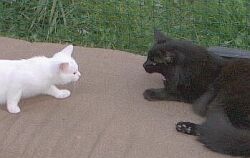
Feline dynamics are not easily understood. Sometimes, as if a switch has been flipped, two cats who have been best of friends for years suddenly act like mortal enemies, and only time will tell if they can recover any of their former fondness.


I worried a little about this possibility after performing an elective surgery on two feline sisters this week. Raised in a small cage at a local shelter, these girls had been unavoidably inseparable their entire lives. So following recovery from anesthesia, we moved the girls into the same large kennel for the duration of their hospital stay. Would the stress and strangeness of their situation unhinge their happy friendship? I sighed with relief when Inky and Binky* started grooming each other affectionately.


Earlier in the week I visited with the owners of a tiny stray kitten. This cute little fuzzball joined a household with two older cats. The male adult is tolerating the kitten's presence (barely) but the older female has objected vehemently! The kitten has been found cowering under a bed in the spare room. She hesitates even to venture out to use the litter box. "Given enough time will they start to get along?" the anxious owners ask. It is impossible to predict how their relationship will change over time.

Cats have unique personalities just like people. A feline household's emotional and political dynamics would probably make a great reality TV show. Let's imagine the above scenario in these terms. "Queenie" is the established feline ruler in this home. She and "Tom," the adult male, have worked out some very intricate rules for coexistence. Queenie puts up with Tom, and Tom has learned to stay out of her way. Introduce little "Orphan Annie." Like a child Annie doesn't understand adult rules of engagement; like a child she can be a whiny, unruly pest. Already henpecked into submission, Tom just rolls his eyes and sighs. Queenie, however, is ticked off that she has to share her space with yet another cat--an obnoxious bratty one to boot--and she is not going to give in without a fight!

Just imagine what it would be like to be locked in a house with another person or two. Not only must you share the same bed and bathroom with these perfect strangers, but you are also expected to eat off the same plate and drink from the same cup for every meal. Now imagine if one of these people is that overbearing, opinionated coworker you just can't stand. Will you ever learn to get along in this artificially constructed home environment? Probably. Will you eventually be best of friends? Eh, probably not.

If Queenie, Tom and Annie are going to find peace in this home they need their own space and resources and plenty of time to work things out. A rule of thumb in cat households is "one litter box per cat plus one." So this home needs four litter boxes. And more importantly, they need to be spaced far apart so Annie doesn't get bullied when she has to go. Queenie should likewise have her own food bowls and dining area so she can eat in peace. Tom, used to putting up and shutting up, will probably be happier with these changes, too.

While Queenie, Tom and Annie may never adore each other like Inky and Binky do, their owners can do a lot to ensure a peaceful coexistence. There are many tips and techniques for introducing new human and animal family members into an existing human-pet dynamic. Ask your veterinarian for suggestions and resources.

UPDATE: I just learned today that Annie has found a new home where she is the only feline family member. She is incredibly happy and doing well!

* Names have been changed to protect privacy.